By DoctorCert Clinical Team
Doctor's Note for Work: A Complete UK Guide to Sickness Evidence & Employee Rights
Understand your rights regarding a doctor's note for work in the UK, including when your employer can request one, Statutory Sick Pay, and private certificate validity.
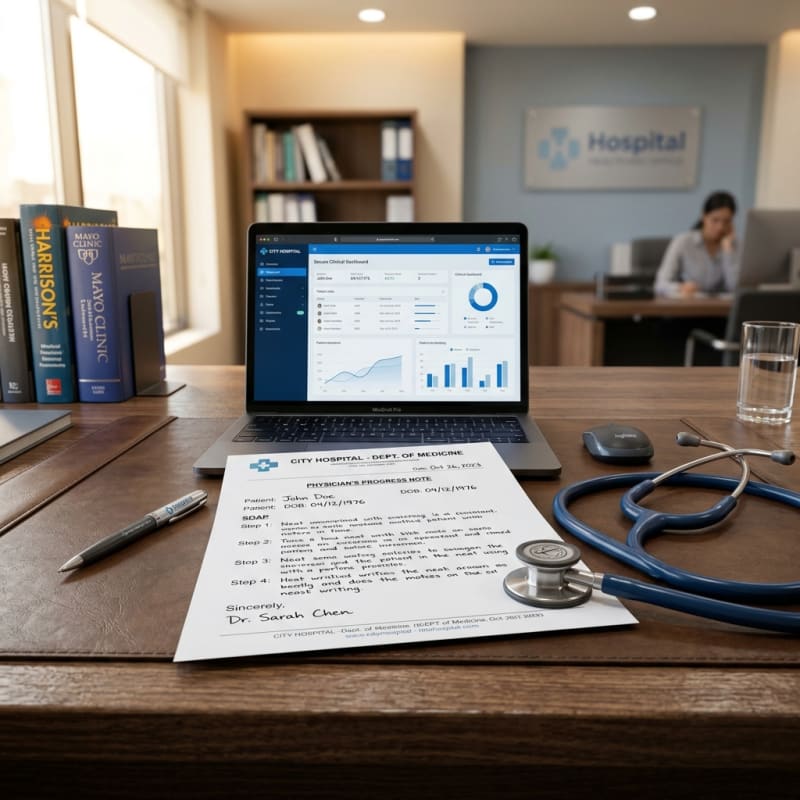
In the United Kingdom, managing sickness absence requires a clear understanding of the balance between employee health needs and employer administrative requirements. A doctor's note for work, officially known as a Statement of Fitness for Work or fit note, is the standard legal document used to verify that an employee is medically unfit to perform their duties due to illness or injury. For employees, securing this documentation on time is essential to protect their employment status, justify their absence, and ensure they receive their sick pay entitlements. For employers, the note provides the clinical guidance needed to manage workplace absence and implement necessary adjustments to support their staff.
Navigating the rules surrounding sickness evidence can be confusing, particularly with the rise of digital healthcare services and recent updates to statutory sick pay regulations. This comprehensive guide provides a detailed breakdown of the legal and clinical frameworks governing doctor's notes for work in the UK. It covers when a note is required, the distinction between self-certification and formal fit notes, how Statutory Sick Pay (SSP) eligibility is determined, and the rights of employees under the Equality Act 2010. If you are currently unfit for work and need a compliant private medical certificate, you can utilize our secure digital review service. To start, check out our private medical certificate overview or submit a request directly on our online booking page for a rapid clinical assessment by a GMC-registered clinician.
What is a Doctor's Note for Work and When is it Required?
A doctor's note for work is an official medical document that certifies a clinician's professional opinion regarding your fitness to perform your job. In the UK, this document was reframed from a "sick note" to a "fit note" in 2010 to focus on what tasks an employee is capable of performing, rather than focusing solely on their incapacity. The note can be signed by a registered General Practitioner (GP), a hospital doctor, or other qualified healthcare professionals, including registered nurses, physiotherapists, and pharmacists.
Under UK employment law, the requirement for a doctor's note is determined by the duration of your sickness absence. For the first seven consecutive calendar days of any illness, you are not required to provide a doctor's note to your employer. Instead, you can self-certify your absence. Sickness reporting must follow your employer's specific policy, which usually requires notification on the first day of absence. On the eighth consecutive calendar day of illness, self-certification is no longer legally sufficient, and you must obtain a formal fit note to continue justifying your absence.
It is vital to understand that the seven-day self-certification period includes non-working days, such as weekends, bank holidays, and scheduled rest days. For example, if you work Monday to Friday and fall ill on a Saturday, you must count the Saturday and Sunday as part of your seven days. If you are still unfit for work on the following Saturday (the eighth day), you must obtain a fit note, even if you are not scheduled to work on that day, to ensure there are no gaps in your medical evidence.
If your employer demands a doctor's note for an absence of seven days or less, they are not entitled to do so as a condition for paying Statutory Sick Pay. However, some companies have internal policies that require immediate proof of illness for contractual sick pay. In such cases, the employer must cover any costs associated with obtaining a private medical certificate, or the employee can choose to pay for a private note independently. Understanding this seven-day threshold is critical to protecting your rights and avoiding unnecessary doctor appointments.
Statutory Sick Pay and Employer Sickness Obligations
When you take time off work due to illness, your entitlement to receive pay is governed by Statutory Sick Pay (SSP) regulations and your specific contract of employment. To qualify for SSP under UK law, you must meet the following criteria: first, you must have an employment contract and have done some work under it; second, your sickness absence must last for at least one full working day; and third, you must provide valid evidence of your illness if requested by your employer (self-certification for the first seven days, and a fit note from the eighth day).
Statutory Sick Pay is paid at £123.25 per week or 80% of your normal weekly earnings, whichever is lower, for up to 28 weeks. It is subject to standard tax and National Insurance deductions. SSP is paid for all full days you are off sick that you would normally have worked. There is no longer a waiting period before payments begin. If you work for multiple employers, you are entitled to claim SSP from each employer separately, provided you meet the eligibility criteria for each contract. For additional details, you can consult the GOV.UK Statutory Sick Pay overview.
Many employers offer Occupational Sick Pay (OSP) schemes, which provide full or partial salary payments during sickness absence, often exceeding the statutory minimum. The terms of OSP are detailed in your employment contract. Some OSP policies may require a medical certificate from the first day of absence to qualify for company sick pay, rather than waiting for the eighth day. In these situations, obtaining a private medical certificate is essential to protect your contractual income, as NHS GPs will not issue fit notes for short-term illnesses of less than a week. In that situation you can get a doctor-signed sick note for work within hours.
If your employer refuses to pay SSP without a valid reason, they are in breach of their statutory duties. Sickness pay disputes can be referred to HM Revenue and Customs (HMRC) for a formal decision. Employers cannot withhold SSP if you fail to provide an NHS fit note, as long as you provide a valid private medical certificate from a GMC-registered doctor. Both forms of evidence are equally valid under UK regulations, and withholding pay under these circumstances can expose the employer to regulatory penalties.
Can an Employer Contact Your Doctor or Reject Your Note?
A common concern for employees is whether their manager can contact their GP to verify a sick note, or whether they have the right to reject a certificate issued by a private or online medical provider. Under UK law, the relationship between a doctor and a patient is protected by strict confidentiality regulations, including the General Data Protection Regulation (GDPR) and the Access to Medical Reports Act 1988. An employer cannot contact your doctor to discuss your medical condition or verify your note without your explicit, written consent.
If an employer wishes to obtain a medical report from your doctor or have you assessed by an occupational health professional, they must make a formal request and secure your written authorization. You have the legal right to view the medical report before it is sent to your employer, and you can request changes if you believe the information is inaccurate or misleading. If you refuse consent, your employer must make decisions regarding your absence and adjustments based on the limited information currently available to them.
A private medical certificate is clinical evidence following an assessment; it is not automatically the same document as a statutory Med3 fit note. An employer may agree to accept appropriate alternative evidence. Confirm the required document before paying, especially for SSP. A GMC registration number or verification code confirms the issuer or authenticity, not guaranteed acceptance or entitlement. See GOV.UK evidence guidance and employer acceptance of private evidence.
To ensure absolute transparency and prevent fraud, secure online services like DoctorCert UK provide a dedicated verification portal. Each certificate we issue contains a unique verification code and QR code. Employers can enter this code on our secure website to verify that the certificate was indeed issued by a registered doctor to that specific patient for the stated period, providing peace of mind for both parties and eliminating administrative delays.
Workplace Adjustments and Phased Return to Work
The primary purpose of a fit note is to facilitate a safe and structured return to work. When a clinician assesses that you "may be fit for work," they are indicating that you could return to duties with temporary modifications, rather than remaining on complete sickness absence. Employers have a legal duty under the Equality Act 2010 to make reasonable adjustments for employees with long-term health conditions or disabilities, and the recommendations on a fit note are key to this process.
The clinician may suggest several types of temporary workplace adjustments on the fit note:
- Altered Hours: Reducing the number of working hours or adjusting shift patterns to help you manage fatigue or attend medical appointments.
- Amended Duties: Removing physically demanding tasks or high-stress responsibilities from your role, allowing you to perform lighter duties during your recovery.
- Workplace Modifications: Providing ergonomic equipment, modifying your workstation, or allowing remote work to accommodate physical limitations.
- Phased Return: A structured plan where you gradually increase your hours and duties over a period of weeks until you return to your full contract.
It is important to understand that while employers are expected to consider these recommendations, they are not legally bound to implement them if they are not practically feasible for the business. For example, a small business may be unable to accommodate a remote working request if the role requires physical presence. If your employer cannot make the recommended adjustments, the fit note must be treated as confirming that you are "not fit for work," allowing you to remain on sickness absence with your pay and employment rights protected.
A phased return is particularly critical for employees returning from long-term sickness absence, major surgery, or mental health conditions. A typical phased return plan might start with the employee working 50% of their normal hours in the first week, progressing to 75% in the second week, and returning to full hours by the third or fourth week. During this transition, regular reviews should be held between the employee and their manager to assess progress and make any necessary tweaks to the adjustments.
How DoctorCert Can Help with Your Sickness Evidence
At DoctorCert UK, we understand that securing a GP appointment when you are unwell can be a stressful and time-consuming experience. Our online platform offers a secure, GMC-compliant alternative, allowing you to request a private medical certificate from the comfort of your home. Every assessment is conducted by a registered UK doctor, ensuring your documentation meets all legal and clinical standards required by employers.
Our service is designed to support your health and streamline your sickness reporting:
- Fast, Asynchronous Assessment: You complete a secure medical questionnaire and upload supporting evidence, such as photos of prescriptions or diagnostic reports, at a time that suits you.
- Fully Compliant Certificates: Our doctors issue valid private fit notes that contain all required details, including the doctor's registration number and recommended workplace adjustments.
- Secure Verification: Each certificate includes a unique verification code and QR code, allowing your employer to instantly verify its authenticity on our secure online portal.
To submit an online consultation request today, visit our booking portal or check our detailed pricing options. We are dedicated to providing professional, fast, and secure medical certificates, helping you focus on your recovery and protect your workplace rights without the hassle of GP appointment queues.
Frequently Asked Questions
Do I need a doctor's note for 3 days off work?
No. Under UK regulations, you do not need a doctor's note for absences of seven consecutive calendar days or less. You can self-certify your illness. However, if your employer operates a private contractual sick pay scheme that requires immediate proof, you may need a private medical certificate.
Can my employer sack me while I am on a sick note?
An employer cannot sack you simply because you are on a sick note, as doing so could lead to a claim for unfair dismissal or discrimination. However, an employer can legally terminate employment during long-term sickness absence if they follow a fair capability procedure and demonstrate that the business cannot sustain your absence.
Is an online private doctor's note legally valid for work?
Yes. Private medical certificates signed by GMC-registered doctors are fully valid under UK law for justifying sickness absence and claiming Statutory Sick Pay (SSP). Employers are required to accept them in the same manner as NHS fit notes.
Can I work while signed off with a doctor's note?
Yes. There is no longer a legal restriction preventing you from returning to work before your fit note expires. If you feel well enough to return, you should discuss this with your employer and agree on any necessary adjustments; you do not need to see a doctor to be signed back to work.
What happens if my doctor's note expires and I'm still sick?
If your fit note is expiring and you remain unfit for work, you must contact your healthcare provider to request an extension. You should do this before the current note expires to prevent any gaps in your medical evidence and avoid delays in your sickness pay.
Sources and guidance
Guidance checked on 9 October 2026. GOV.UK SSP amounts; GOV.UK sickness evidence.


