By DoctorCert Clinical Team
What Does a Sick Note Look Like in the UK?
What does a sick note look like in the UK? Learn the main sections of a fit note, what makes it valid, and how digital notes differ from older forms.
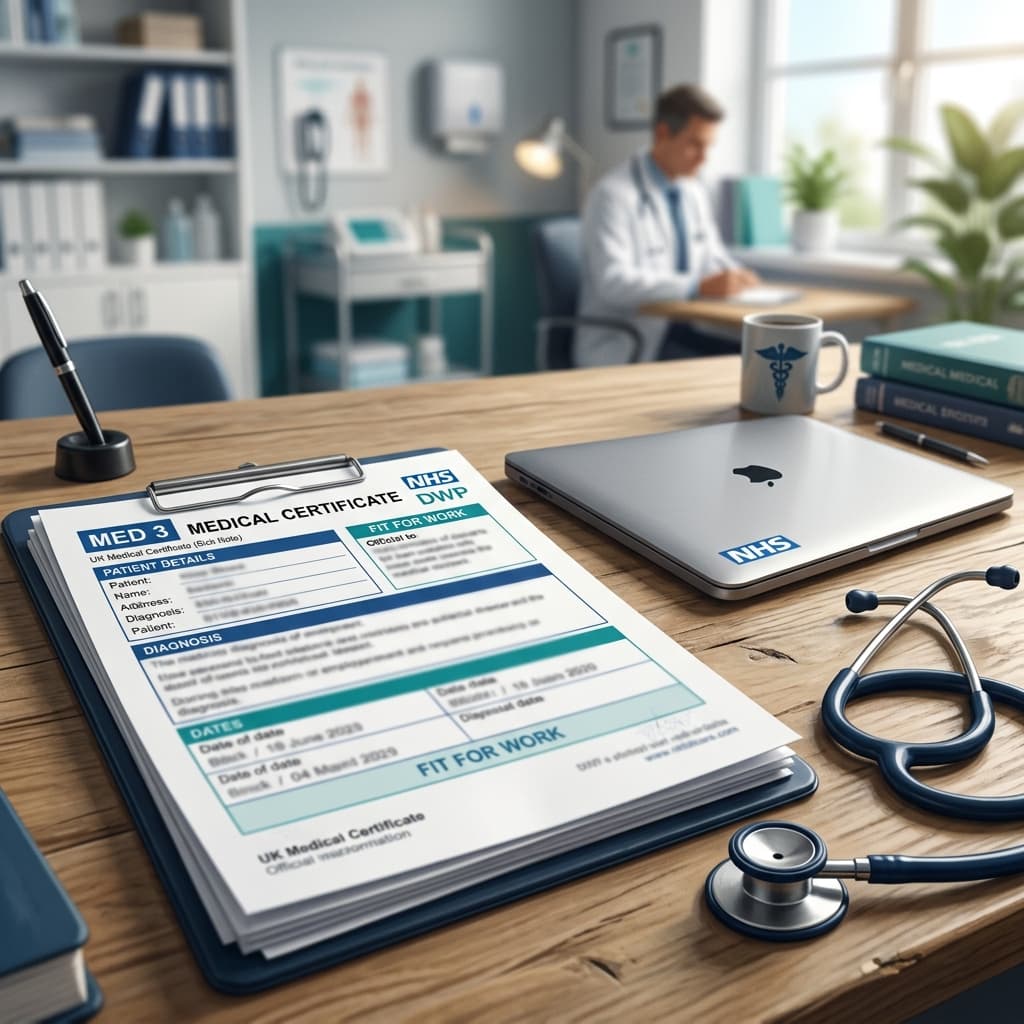
A sick note in the UK usually means a fit note, officially called a Statement of Fitness for Work or Med 3 form. If you have never seen one before, it can be hard to know what you should be looking for, especially now that fit notes may be issued digitally, may come from several types of healthcare professional, and may look slightly different depending on when and where they were issued.
This guide explains what a current UK sick note looks like, which details matter, what makes one valid, how the older and newer versions differ, and how a private medical certificate compares if your employer accepts alternative medical evidence.
The aim is practical clarity. If you are an employee, you should know what details to expect before you send the document to work. If you are an employer or manager, you should know what information can appear on a genuine fit note and what does not have to be there.
The basic answer
A UK sick note is usually a form showing:
- the date you were assessed
- the health condition affecting fitness for work
- whether you are not fit for work or may be fit for work
- any advice about workplace adjustments
- the period the note covers
- whether the healthcare professional needs to assess you again at the end
- the issuer's name and profession
- the date the note was issued
- the medical practice address
That summary comes directly from the official government annex explaining the form to patients, employees, and employers.
The official name of the document
Although most people still say sick note, the official NHS and DWP document is the fit note. GOV.UK says the Statement of Fitness for Work, commonly known as the fit note or Med 3 form, replaced the old-style sick note in 2010.
That is why you may see all of these terms used for roughly the same thing:
- sick note
- fit note
- doctor's note
- medical certificate
- Med 3
In strict UK employment terms, the fit note is the official work-and-benefits document. A private medical certificate is a different form of evidence, though employers may accept it in the same way subject to their agreement.
What the current fit note form contains
The clearest official breakdown comes from the DWP annex explaining the form. Here is what each section means in plain English.
1. Date of assessment
This is the date the healthcare professional assessed you, whether in person, by video call, by telephone, or after considering a report from another healthcare professional. It is not always the same as the date the document itself was issued.
2. Health condition affecting fitness for work
This section names the condition affecting your fitness for work. The official guidance says it is usually best for the healthcare professional to be as accurate as possible, but they can use a less precise diagnosis if being too detailed might harm your position with your employer.
That is why you may sometimes see a broader description rather than a long diagnostic explanation.
3. Assessment: may be fit or not fit
The form will say either may be fit for work or not fit for work. If it says may be fit, that means the clinician believes you may be able to work if adjustments are made. If it says not fit, that means they think you are not fit for work of any kind for the period covered.
4. Advice about support or adjustments
The comments box and any tick-box recommendations tell the employer how the condition affects work and what support might help. GOV.UK lists phased return, altered hours, amended duties, and workplace adaptations as the main examples.
This part matters more than many people realise. It is often the part employers use most when discussing how to help someone stay in or return to work.
5. The period covered
This section gives the time period the note covers. The annex for patients says this section may cover a previous period if the healthcare professional thinks your condition affected fitness for work before the assessment. That is one reason the fit note can sometimes include earlier dates.
6. Whether you need reassessment
The form says whether the healthcare professional needs to assess your fitness for work again at the end of the period. If they do not expect the condition to keep affecting your fitness after expiry, they may say they do not need to see you again.
7 and 8. Issuer name and profession
Current official guidance says the note must include the issuer's name and profession. Following 2022 changes, fit notes can be authorised digitally and no longer always require an ink signature. That means the issuer details matter more than people sometimes expect.
9. Date of statement and practice address
The date of statement is when the fit note was issued. The official annex says this may not always be the same as the date of assessment. The practice address should also be shown.
What a valid fit note should look like
A fit note does not have to arrive on one single visual template to be valid. It can be digital or printed, computer-generated or occasionally handwritten, and sometimes an older version will still appear during rollout differences. But some features are consistently important.
- It should show the issuer's name and profession.
- It should show the practice address.
- It should include an assessment and a covered period.
- It should clearly say may be fit or not fit.
- If issued digitally or printed from the healthcare IT system, it may include a barcode.
- If it is an older form, it may carry an ink signature instead of the newer digital authorisation style.
The employer guidance is especially clear here: if the fit note does not include the healthcare professional's signature or name, it should not be accepted because it may not be genuine.
Digital fit note vs older paper fit note
One source of confusion is that the fit note changed in 2022. GOV.UK says a new version of the fit note was introduced to replace the signature in ink with the name and profession of the issuer. That means people can now receive a fit note through digital channels where the local IT system supports it.
In practical terms, that means you might receive:
- a digital PDF sent to you
- a printed version from a GP or hospital system
- an older signed-in-ink paper form during ongoing system rollout
All of these can still be valid. The employer guide says an older version remains legally valid provided it has been signed by the healthcare professional.
What a sick note does not need to include
People often expect a fit note to contain far more detail than it actually should. In most cases it does not need to include:
- your full medical history
- detailed test results
- every symptom you described in consultation
- a full explanation of personal circumstances
- evidence that you are fit for work again
That final point matters because there is no standard fit note option that says you are fit for work. GOV.UK says healthcare professionals cannot give a fit note stating that you are fit for work, and people do not need to be signed back to work.
If you are dealing with the question of going back before the note ends, read our guide to returning before a sick note ends.
What a private medical certificate looks like
A private medical certificate is not exactly the same document as an NHS fit note, but it will often contain very similar core information when issued properly. Government employer guidance says alternative forms of medical evidence, including private medical certificates, can be accepted in the same way as a fit note subject to employer agreement.
A credible private certificate usually includes:
- the patient's details
- the doctor's name and professional identity
- the date of issue
- the covered dates
- a statement that the person was or is not fit for work, study, or another defined purpose
- practice or provider details
It may not visually match the Med 3 template. That does not automatically make it invalid. What matters is whether it is genuine, clinically supported, and accepted by the organisation asking for the evidence. For the broader comparison, read our NHS fit note vs private certificate guide.
How employers usually check a sick note
Employers generally do not need your full records. The employer guidance says they may take a copy of the fit note for their records, while the employee should keep the original. The same guidance also says employers must keep the information confidential and only make it available to people who genuinely need it, such as HR.
In most cases employers are looking for a few practical things:
- Is the note genuine?
- Does it include the issuer details?
- What dates does it cover?
- Does it say may be fit or not fit?
- Are any adjustments suggested?
That is why a neat digital note with clear dates and issuer details is often more useful than a vague letter.
Common reasons people think a fit note looks wrong
A lot of the searches around what a sick note looks like are really worry searches. People receive a note that looks different from what they expected and assume something is wrong. Usually, the explanation is simpler.
- It is digital, not signed in ink. This may be normal under the newer 2022 format.
- It came from a nurse, physiotherapist, pharmacist, or occupational therapist. This can be valid because those professions can now issue fit notes when appropriately involved in care.
- The diagnosis is broad. The guidance says clinicians can be less precise if a detailed diagnosis might harm your position with an employer.
- The issue date is different from the assessment date. The official annexes say these dates are not always the same.
- It covers an earlier period. The official annex explains that the covered period may include an earlier period if the clinician thinks fitness for work was affected before the assessment.
If the document is missing the issuer's name or signature details entirely, that is different. In that situation the employer guidance says it should not be accepted as it may not be genuine.
When the document you need is not a standard fit note
Sometimes people search for what a sick note looks like when they really need to understand a slightly different document, such as:
- a Med10 hospital form
- a private medical certificate
- a fit-to-work certificate
- a university mitigation letter
- an insurance medical letter
Those documents may look different because they are different. For example, a private employer-facing certificate from DoctorCert will not copy the exact NHS Med 3 layout, but it can still serve as legitimate medical evidence where accepted.
If you need a fast private route, you can also see how the online process works or start your request here.
Frequently Asked Questions
Does a UK sick note have to be signed in ink?
No. Since the 2022 changes, fit notes can be authorised digitally and include the issuer's name and profession rather than always needing an ink signature. Older signed paper versions can still be valid too.
What details make a fit note valid?
The key details are the assessment outcome, covered period, issuer name and profession, issue date, and practice address. If the note does not include the healthcare professional's name or signature details at all, government employer guidance says it should not be accepted.
Can a fit note be emailed as a PDF?
Yes. GOV.UK says people can receive fit notes through digital channels where the local IT system supports this. That means a digital note sent electronically can still be genuine and valid.
Will a private medical certificate look the same as an NHS fit note?
Not necessarily. A private certificate often uses a different layout, but it can still contain the same core medical-evidence information. Employer guidance says private medical certificates can be accepted as medical evidence subject to employer agreement.
Why does my fit note say may be fit for work?
That means the healthcare professional thinks you may be able to work if adjustments are made. It is not the same as saying you are fully fit as normal. The note should be used to discuss whether the employer can support a return with changes.
The practical takeaway
A genuine UK sick note is usually a fit note showing the assessment date, the condition affecting fitness for work, the may be fit or not fit outcome, any work-related advice, the covered period, and the issuer's name, profession, and practice details. It may be digital, printed, or on an older signed template.
If you need private medical evidence rather than an NHS fit note, start your DoctorCert request here.
Check the document type before its appearance
A different layout is not enough to decide whether a document is genuine or appropriate. First establish whether it is a statutory fit note, an appointment confirmation, an OH report or a private certificate. They do not all use the same format or serve the same purpose.
Keep the original and use a published contact route if details need clarification. Checking a doctor's registration is useful, but it does not authenticate the content of a particular PDF by itself.
- Check the person, issuer, supported dates and true issue date.
- Look for the assessment and any stated limitations or review.
- Ask the recipient what form it needs before buying an additional document.
Editorial sources and scope
Sources checked on 16 October 2026: GOV.UK guidance 1; GOV.UK guidance 2.
This article provides general information. It is not an individual clinical assessment or employment-law decision. A private certificate is issued only where the reviewing doctor can support it, and the recipient decides whether it meets the required purpose.

