By DoctorCert Clinical Team
How to Get a Sick Note From a GP: UK Sickness Rules and Online Alternatives
A complete guide on obtaining a GP sick note in the UK, including appointment rules, backdating, self-certification, and GMC-compliant online private alternatives.
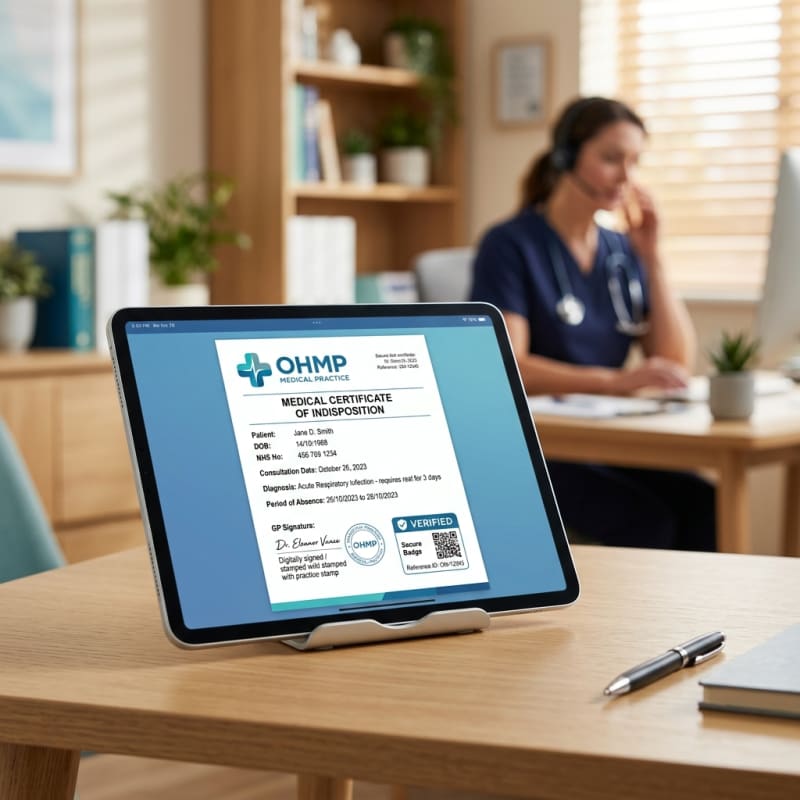
If illness affects your ability to work, contact the service responsible for your care and explain the symptoms, dates and work limitations. A GP may use a telephone, video or other appropriate assessment rather than always requiring a face-to-face appointment. The clinician decides what information is needed before issuing a fit note.
DoctorCert offers an online request for a private medical certificate. Complete the booking questionnaire accurately; a GMC-registered doctor reviews the information and may decline the request or need further information. This is a documentation assessment, not a replacement for examination, tests, treatment or your usual care team. Check the service scope, price and refund policy before booking.
UK Sickness Regulations and the Seven-Day Self-Certification Window
Under the Social Security Administration Act 1992 and the Statutory Sick Pay (General) Regulations 1982, employees in the United Kingdom are not required to provide medical evidence from a doctor for the first seven consecutive calendar days of any sickness absence. This initial period is officially designated as the self-certification window. If you are unfit for work for a week or less, you are legally entitled to declare your own illness by completing a self-certification form. This can be the standard Statutory Self-Certification (SC2) form provided by HM Revenue and Customs, or your employer's internal sickness reporting documentation.
Count the illness in calendar days, including weekends and non-working days. If sickness lasts into day eight, ask what further evidence the employer requires. The number of work shifts missed is a separate payroll question; it does not change the seven-calendar-day evidence boundary.
Follow the sickness reporting procedure and keep a record of when you notified your employer. For SSP, medical evidence is not normally required for the first seven calendar days. If early evidence is requested for another purpose, clarify what document is needed, whether private evidence is accepted and who covers the fee. A company policy does not replace the statutory SSP evidence rules.
The purpose of the self-certification window is to prevent the NHS from being overwhelmed by patients with short-term, self-limiting illnesses such as minor viral infections, mild food poisoning, or acute tension headaches. By allowing individuals to rest and recover at home without the need to visit a surgery, the regulations preserve GP appointment capacity for patients with more complex or severe clinical needs. Understanding this threshold is the first step in managing your sickness absence compliant with UK regulations.
How to Request a Fit Note from an NHS GP Practice
Contact the GP practice or treating service through its published request process and give the relevant dates, symptoms and effect on work. An assessment may be by telephone, video, in person or based on appropriate clinical information. The service decides which approach is suitable.
During the consultation, the GP will perform a clinical assessment to evaluate how your condition affects your ability to perform your specific job duties. They will review your medical history, current symptoms, and any diagnostic reports. The clinician is not merely assessing whether you are ill; they are evaluating whether your illness makes you unfit to work. For instance, a broken wrist may render a manual builder unfit for work, but a call center operator with the same injury may still be capable of performing their duties with minor adjustments.
Following the assessment, the GP will issue a fit note stating one of two options: "you are not fit for work" or "you may be fit for work." If they select "not fit for work," they will specify the duration of the certificate and the clinical reason for the absence. If they select "may be fit for work," they will outline recommended workplace adjustments, such as altered hours, amended duties, or workplace modifications, to facilitate a safe, gradual return. This recommendation is designed to encourage discussion between you and your employer.
Due to the high demand for NHS appointments, obtaining a consultation on the exact day your self-certification expires can be extremely challenging. Many surgeries require patients to call at 8:00 AM for same-day bookings, leading to long queues and frequent frustrations. If you experience a delay in securing an appointment, you should inform your employer immediately. GPs are permitted to write fit notes that overlap or cover prior periods, provided there is clear clinical evidence of your illness during that time. However, to avoid any administrative issues or delays in your sick pay, you should initiate the request as early as possible.
When Can a GP Refuse to Issue a Sick Note?
It is a common misconception that GPs are obligated to issue a fit note upon request. In reality, a GP can refuse to sign a sick note if they determine, after a clinical assessment, that you are fit to perform your duties or if there is insufficient clinical evidence to support your claim of illness. Because a fit note is a legal document certifying a medical opinion, the clinician must act in accordance with their professional judgment and the guidelines set by the General Medical Council (GMC) and the Department for Work and Pensions (DWP).
A clinician may be unable to support the requested evidence because self-certification is appropriate, the dates are unclear or more information about symptoms and work is needed. Symptoms do not need to appear on a scan to be real. Ask what the clinician needs to understand the functional effect and what should happen next.
Ask for the reason and what information or reassessment would be appropriate. If seeking another opinion, be open about the first decision and describe the symptoms and work effects accurately. Repeatedly changing provider does not guarantee a certificate or resolve a disagreement about the required evidence.
A face-to-face visit is not always necessary, but the clinician must decide whether the information is sufficient. Ask the practice how to arrange an appropriate assessment. If the concern is about service or conduct, use its review or complaints process; that does not guarantee the requested note.
The Rules Governing Retrospective and Backdated Fit Notes
A frequent concern for employees is whether a doctor can write a backdated sick note to cover a period of absence that has already occurred. Under UK regulations, GPs and other registered clinicians are legally permitted to issue retrospective fit notes. This is a common and necessary practice, as patients are often too unwell to visit a surgery during the acute phase of their illness, or they may face delays in securing an appointment with their doctor.
To issue a backdated fit note, the clinician must be satisfied that there is clear medical evidence that you were unfit for work during the specified historical period. This evidence can come from several sources, including: first, your medical records, such as notes from a recent hospital admission, an A&E attendance, or a consultation with another healthcare professional; second, the natural clinical progression of your condition, where your current symptoms during the consultation make it clear you were unwell previously; or third, a detailed discussion of your symptoms and history that convinces the doctor of your past incapacity.
There is no statutory limit on how far back a fit note can be backdated, provided the clinical justification is sound. However, doctors are expected to exercise professional caution when writing retrospective certificates. A GP will rarely backdate a note for several weeks or months without substantial documentary evidence, such as a specialist report or diagnostic test results. If you consult a doctor for the first time after recovering from a brief illness, they may decline to write a retrospective note because they cannot verify your past condition. Therefore, it is essential to contact a healthcare provider as soon as you become unwell, even if you do not require an immediate appointment, to establish a medical record of your condition.
Online Private Alternatives to NHS GP Sick Notes
A private medical certificate is clinical evidence following an assessment; it is not automatically the same document as a statutory Med3 fit note. An employer may agree to accept appropriate alternative evidence. Confirm the required document before paying, especially for SSP. A GMC registration number or verification code confirms the issuer or authenticity, not guaranteed acceptance or entitlement. See GOV.UK evidence guidance and employer acceptance of private evidence.
Before payment, ask the recipient to confirm the document and dates it needs. If it wants a statutory or specialist form, check that the service can provide it rather than assuming that a general private letter is interchangeable.
The primary advantages of using an online private service include:
- Speed and Convenience: Assessments are typically completed within hours, allowing you to secure your certificate without delays and avoid gaps in your sickness records.
- Accessibility: You can submit a request from the comfort of your home at any time, which is particularly beneficial when you are suffering from acute symptoms or mobility limitations.
- Reduced Burden on the NHS: By using a private service for routine administrative documentation, you help free up valuable GP appointment capacity for patients who require urgent, hands-on clinical care.
The recipient can check the doctor's registration on the GMC register and contact the issuing service through a published contact route if authenticity needs checking. A GMC entry confirms registration, not that a particular document was issued or must be accepted. Do not send full medical records to an unverified contact.
How DoctorCert Can Help with Your Sickness Evidence
Use accurate dates and describe the symptoms and work effects in your own words. The booking questionnaire is an information-gathering step, not a promise that the reviewing doctor can issue the requested evidence.
Our digital process is designed to support your recovery and protect your employment rights:
- Explain the symptoms, relevant dates and how they affect your work in the booking questionnaire.
- A GMC-registered doctor reviews the request. Issuance and the dates covered depend on that assessment.
- If approved, the private certificate is sent digitally. Confirm that the recipient accepts this evidence before requesting it.
- If the doctor cannot issue a certificate, the published refund policy applies. Seek appropriate medical care for symptoms.
If more information or another type of assessment is needed, follow the clinician's advice. A certificate cannot replace treatment or a safety assessment. Contact the service through its published route if the administrative process is unclear.
Frequently Asked Questions
How long does a GP sick note last?
For the first six months of a sickness absence, a GP can write a fit note for a maximum duration of three months. After six months of ongoing absence, the certificate can be issued for any clinically justified period, including "indefinitely," depending on the patient's prognosis and recovery.
Do GPs charge for a sick note?
NHS GPs do not charge a fee for issuing a Statement of Fitness for Work (fit note) if your illness has lasted more than seven consecutive calendar days. However, if your employer requests medical evidence during the initial seven-day self-certification window, the GP practice may charge a fee for providing a private medical certificate.
Can I get a sick note without seeing a GP?
Yes. You can obtain a valid fit note or medical certificate from other registered healthcare professionals, including hospital doctors, registered nurses, occupational therapists, physiotherapists, pharmacists, or GMC-registered online private medical services.
Can an employer reject a GP-signed fit note?
A private medical certificate is clinical evidence following an assessment; it is not automatically the same document as a statutory Med3 fit note. An employer may agree to accept appropriate alternative evidence. Confirm the required document before paying, especially for SSP. A GMC registration number or verification code confirms the issuer or authenticity, not guaranteed acceptance or entitlement. See GOV.UK evidence guidance and employer acceptance of private evidence.
What happens if my GP is closed?
Check your practice's advice for routine requests outside opening hours. Use the appropriate urgent-care service if symptoms need prompt attention; an urgent service is not an administrative shortcut to a guaranteed certificate. Tell the employer if evidence is delayed.
Sources and guidance
Guidance checked on 9 October 2026. GOV.UK SSP amounts; GOV.UK sickness evidence.
What to include in the practice request
Give the dates work has been affected, the main symptoms, relevant treatment and the type of job. Say if there is existing hospital or other clinical information. The practice decides how to assess the request; a phone or video review may be suitable but cannot be guaranteed in advance.
Ask how to receive and supply the document and what to do if symptoms continue. If the clinician refuses, ask for the reason and next step rather than treating a private purchase as a guaranteed override.
- Use the practice's published request process.
- Keep the employer informed about delays.
- Use urgent care for symptoms, not as an administrative shortcut.
Editorial sources and scope
Sources checked on 16 October 2026: GOV.UK guidance 1; NHS guidance 2.
This article provides general information. It is not an individual clinical assessment or employment-law decision. A private certificate is issued only where the reviewing doctor can support it, and the recipient decides whether it meets the required purpose.