By DoctorCert Clinical Team
Can You Get a Sick Note Without Seeing a Doctor in the UK?
Discover how to get a sick note without seeing a doctor in the UK. Learn about self-certification, NHS telephone reviews, and online private certificates.

You do not always need a face-to-face GP appointment to obtain sickness evidence. The right route depends on how long you have been absent, the information needed for an assessment and the document your employer or university accepts.
The direct answer is yes. Sickness absence rules in the UK are designed to accommodate remote assessments, clinical delegation, and digital evidence. You do not always need to travel to a clinic or sit in a physical waiting room to secure the medical evidence required by your employer or university.
In this comprehensive guide, we will break down the exact rules governing remote sick notes (officially known as fit notes in the NHS) in the UK. We will cover self-certification, NHS phone and video reviews, the statutory expansion of healthcare professionals who can sign off on absence, and how secure online private services provide a legitimate, efficient alternative.
Quick answer: Can you get a sick note without a face-to-face GP visit?
Yes. You can legally get a sick note without seeing a doctor in person through several recognized channels. In the UK healthcare system, face-to-face consultations are not a strict prerequisite for medical evidence. Healthcare providers can perform assessments and issue documentation remotely based on telephone consultations, video reviews, or written reports.
For SSP purposes, employees normally self-certify for the first seven calendar days. After that, an employer can ask for a statutory fit note or agree another appropriate form of evidence. A remote appointment may be suitable, but a clinician must decide whether enough information is available.
The first 7 days: Legally self-certifying your sickness absence
Before worrying about GP appointments or remote certificates, it is vital to check how long you have actually been unwell. One of the most common misunderstandings in UK workplaces is that employers require a doctor-signed note from day one of any sickness absence.
Statutory UK guidelines state that you do not need to provide a doctor-signed fit note for the first 7 calendar days of sickness. Instead, you can self-certify. This period is based on consecutive calendar days, not working days. This means weekends, bank holidays, and scheduled rest days count toward the seven-day limit.
To self-certify, you simply need to inform your employer that you are unfit for work. Many employers have their own internal self-certification forms, or you can use the official UK Government SC2 form (Employee's Statement of Sickness). If you need detailed guidance on how to navigate this initial week, you can read our complete guide to self-certification for the first 7 days to understand your rights.
If an employer insists on receiving a doctor-signed note during this first week, they are asking for something outside the standard statutory framework. GPs and private clinics can charge a fee for issuing a certificate within the first seven days, and official ACAS guidance states that the employer should cover this cost.
Legally valid ways to get a remote NHS fit note
If your illness extends beyond the seven-day self-certification threshold, you will need official medical evidence. If you choose the NHS route, you still do not necessarily need to be seen in a face-to-face clinic room. The NHS supports several remote assessment paths:
1. Telephone and video consultations
GPs and practice nurses frequently conduct telephone or video assessments. If the clinician can establish a clear diagnosis, understand the functional impact of your illness on your job, and discuss your recovery path over the phone, they can issue a digital fit note. This note can be emailed to you as a PDF or sent via a secure SMS link.
2. Reviews based on third-party medical evidence
A clinician may issue a fit note after considering a written report from another healthcare professional, such as a discharge summary. The clinician still decides whether the information supports an opinion; access to a report does not guarantee a note.
3. The July 2022 statutory expansion
To ease pressure on GPs, the UK Government updated the law in July 2022, expanding the list of healthcare professionals authorized to sign off on fit notes. You no longer need to see a doctor specifically to get an NHS fit note. The following registered professionals can now assess and issue fit notes within their clinical scope:
- Doctors
- Registered nurses
- Occupational therapists
- Pharmacists
- Physiotherapists
This means that if you are recovering from a musculoskeletal injury, a physiotherapist at your GP practice can sign your fit note. If you have been managed by a specialist nurse, they can sign it. For more details on who can officially issue these documents under the new rules, you can review our guide on who can issue a fit note in the UK to see how this legislation works.
How private online medical certificates work
A private online assessment is another option when the recipient accepts the document and the request is suitable for remote review. Check your usual clinician’s options and the evidence required before choosing a paid service.
DoctorCert operates a safe, asynchronous remote assessment model. Rather than booking a live video call or traveling to an in-person clinic, patients submit a comprehensive, structured clinical questionnaire online. This request is then reviewed by a real, GMC-registered doctor.
Provide accurate information requested in the online form, including:
- Symptoms and their effect on your activities or ability to work.
- The dates you were unwell and relevant details requested during the assessment.
- Any clarification requested by the reviewing doctor. Do not assume a service offers document or image uploads unless the form provides that facility.
A GMC-registered doctor reviews this clinical evidence. If they determine that your request is appropriate and your illness renders you unfit for work, they will issue a secure, signed private medical certificate. This certificate is delivered directly to your email inbox as a professional PDF, usually within two hours during business hours.
To learn more about the structure and legal standing of private certificates, you can explore our overview of private medical certificate features to see how we maintain clinical integrity.
Understanding the legal validity of private certificates
Remote issue alone does not determine acceptance. The type of document, the clinical assessment and the recipient’s policy all matter.
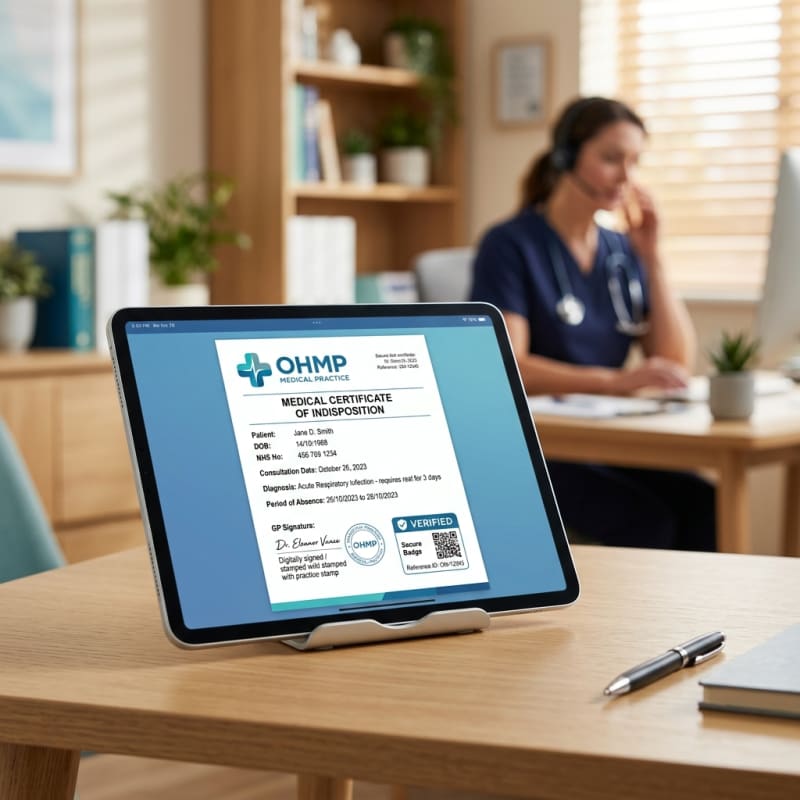
A private medical certificate is clinical evidence following an assessment; it is not automatically the same document as a statutory Med3 fit note. An employer may agree to accept appropriate alternative evidence. Confirm the required document before paying, especially for SSP. A GMC registration number or verification code confirms the issuer or authenticity, not guaranteed acceptance or entitlement.
To protect both the patient and the organization receiving the document, DoctorCert includes robust security features on every issued certificate:
- GMC registration numbers: Every certificate clearly displays the reviewing doctor's name and official General Medical Council registration number, which is fully verifiable on the GMC register.
- Unique verification IDs: Each PDF includes a secure, unique reference code. Employers can verify the authenticity of the document securely, protecting against fraud.
- Clinical detail: The certificate is prepared in plain English, stating the clinical opinion clearly and concisely.
If you want to understand the exact differences in legal standing, payroll acceptance, and employer policies between public and private documents, read our analysis comparing a private medical certificate vs an NHS fit note to help you make an informed choice.
When Remote Assessments Are NOT Appropriate
While remote medical reviews are highly convenient for a wide range of common, self-limiting, or stable conditions, they are not a universal solution for every clinical scenario. Clinical safety is our absolute priority, and there are situations where you must seek emergency medical care or an in-person review:
- Emergency symptoms: call 999 or go to A&E for a medical emergency. Do not wait for a certificate assessment.
- Conditions needing examination, tests or ongoing treatment: contact the appropriate GP or specialist service. A certificate review does not replace that care.
- Benefit evidence: ESA and Universal Credit may require statutory fit-note evidence under their own rules. PIP is different: a Med3 fit note is not the usual application prerequisite. Follow the benefit’s evidence instructions rather than buying a certificate on that assumption.
If the doctor cannot issue a certificate, the request is declined and the fee is refunded in line with the published refund policy. A certificate request does not replace treatment or urgent medical care.
Choosing the right acquisition path for your needs
Ask your GP practice or treating team about remote fit-note assessment if you need statutory evidence. A fit note for sickness lasting more than seven days is normally free. Private letters and certificates for other purposes may attract charges.
For university or employer deadlines, contact the recipient promptly and check whether evidence can follow later. A private remote review may be an option, but approval, timing and acceptance cannot be guaranteed.
For general work-related absences, you can check our dedicated page on getting a sick note for work to see how we match employer expectations. If you need a broad online consultation, you can review our online sick note service or start your secure request directly.
If you are ready to proceed with a secure remote review by a GMC-registered clinician, you can check our clear, transparent pricing details and start your consultation today.
Frequently Asked Questions
Can you get a sick note without seeing a doctor?
Yes, a face-to-face GP visit is not always required. Statutory fit notes can follow telephone, video or relevant written-report assessments, and authorised professionals besides doctors can issue them within their competence. Private online certificates are a separate option subject to assessment and recipient requirements.
Can a GP refuse to give you a sick note without seeing you?
A GP can decline to issue a fit note if they believe they cannot make a safe clinical assessment without a physical examination. Sickness certification is a professional clinical decision. If they cannot verify your condition remotely, they will ask you to book an in-person appointment or seek further care.
Is an online private sick note legally valid in the UK?
A private medical certificate is clinical evidence following an assessment; it is not automatically the same document as a statutory Med3 fit note. An employer may agree to accept appropriate alternative evidence. Confirm the required document before paying, especially for SSP. A GMC registration number or verification code confirms the issuer or authenticity, not guaranteed acceptance or entitlement.
Do I need a doctor's note for a 3-day or 5-day absence?
For SSP purposes, employees normally self-certify for sickness lasting seven calendar days or fewer. The need for medical care is separate. Employers requesting extra private evidence during that period should cover the cost; other recipients may have different rules.
What should I do if my GP has no appointments but I need a fit note?
Ask the recipient whether it accepts a private medical certificate for this purpose. A DoctorCert assessment is for private sickness evidence; it does not automatically produce the statutory Med3 document or establish SSP entitlement. The clinician decides whether the information supports a certificate and the dates requested. If a particular form is required, confirm that before paying.
Need a medical certificate?
DoctorCert offers an online request for a private medical certificate. Complete the booking questionnaire accurately; a GMC-registered doctor reviews the information and may decline the request or need further information. This is a documentation assessment, not a replacement for examination, tests, treatment or your usual care team. Check the service scope, price and refund policy before booking.
Sources and guidance
Guidance checked on 9 October 2026. GOV.UK sickness evidence; GOV.UK fit note guidance; GOV.UK PIP applications.
Remote assessment is still an assessment
Explain whether you mean without a face-to-face visit or without any clinical assessment at all. A suitable remote assessment may avoid a clinic visit, but it does not remove the need for professional judgement. The clinician can ask for another type of assessment where the information is insufficient.
For the statutory route, contact the service involved in your treatment. For private evidence, check the employer's agreement and provider scope. The route should fit the need rather than simply being the fastest advertised option.
- Use self-certification for the ordinary first-week evidence process.
- Describe the symptoms and work effects rather than demanding a document.
- Seek appropriate care if an examination or urgent review is needed.
Editorial sources and scope
Sources checked on 16 October 2026: GOV.UK guidance 1; GOV.UK guidance 2.
This article provides general information. It is not an individual clinical assessment or employment-law decision. A private certificate is issued only where the reviewing doctor can support it, and the recipient decides whether it meets the required purpose.