By DoctorCert Clinical Team
What to Do If Your GP Refused a Sick Note: A UK Guide
Has your NHS GP refused to issue a fit note or sick note? Understand your legal rights, why doctors refuse, and the secure private alternatives available.

If a GP refuses a sick note, ask what led to the decision and what should happen next. The issue may be the evidence available, the dates requested, the effect of symptoms on work or whether self-certification is the right route. A refusal does not by itself mean that your symptoms are unimportant.
This guide focuses on the next steps after a refusal: understanding the reason, giving accurate information, keeping the employer informed and seeking an appropriate reassessment or review. Paying another provider does not guarantee a different decision.
For the underlying clinical reasons, read why a doctor may refuse a sick note. Here the focus is a practical action plan, not finding a provider who will issue a predetermined certificate.
Why Do GPs Refuse to Issue Fit Notes?
To handle a refusal effectively, you must first understand the clinical and statutory framework that GPs operate under. A common misconception among patients is that a fit note is an administrative right or a customer service request. In the UK, a fit note is a formal medical statement that requires a registered clinician to make an independent clinical judgment.
A fit note records a clinical assessment of how health affects fitness for work. If the requested document cannot be supported, ask which part of the information or evidence process needs clarification. The reason should guide the next step:
- Ask whether the clinician thinks self-certification is appropriate for the dates involved.
- Ask whether more detail about the symptoms, treatment or actual job would help the assessment.
- Check whether a may-be-fit note with adjustments was considered.
- If workplace conflict is involved, explain any health effects accurately; conflict alone and a medical condition are not the same question.
To understand the legal boundaries regarding what employers can verify, you can read our detailed guide on can an employer contact your doctor about a sick note to see how medical confidentiality protects your patient record during disputes.
If the first appointment did not cover the relevant symptoms or work duties, explain what was missed and ask how to provide it. Appointment arrangements vary; the length of a consultation does not by itself establish why a certificate was refused.
GMC Guidance and Professional Clinical Duty
GMC guidance on sickness certification is explicit. Doctors have a clear professional obligation to act with total clinical integrity. This means they must never issue a certificate that contains misleading or inaccurate statements. If a doctor signs a certificate declaring you are unfit for work without a robust clinical justification, they are breaching their professional guidelines, which can trigger an investigation by the General Medical Council.
An assessment can be reviewed if relevant information was missing or the situation has changed. Give an accurate account of the previous decision and the new information. Another clinician may still reach the same view.
A further assessment should be chosen for its clinical suitability and the evidence required. Confirm whether an NHS reassessment, treating-team review or agreed private evidence meets the need; payment does not guarantee a particular clinical opinion.
Your Legal Rights as an NHS Patient
You can ask for an explanation and seek further assessment, but another clinician is not obliged to agree with the requested wording or dates. If you believe the consultation or service was handled improperly, ask about the practice's complaints process. A complaint is not a guarantee that a certificate will be issued.
However, you are fully entitled to take the following constructive steps within the NHS system:
- Write down the reason given for refusal and any suggested next step.
- Provide relevant new information or seek reassessment if symptoms change or worsen.
- Ask about clinically appropriate adjustments rather than insisting on one particular outcome.
- If the concern is about the service or conduct, use the practice's review or complaints route.
For an NHS service complaint in England, follow the practice or responsible NHS organisation's complaints process first. An unresolved eligible complaint may be taken to the Parliamentary and Health Service Ombudsman. Scotland, Wales and Northern Ireland have their own routes. A complaint does not replace urgent care or decide an employment dispute.
Keep your employer informed about the absence and any delay obtaining evidence. A late fit note alone is not grounds to withhold SSP; notification rules and contractual sick-pay terms are separate. Ask payroll to explain a refusal in writing rather than assuming that a paperwork gap removes employment protections.
If you want to understand how online clinical consults work and what to expect during a remote evaluation, you can read our guide on online sick note consultations which breaks down the telemedicine process.
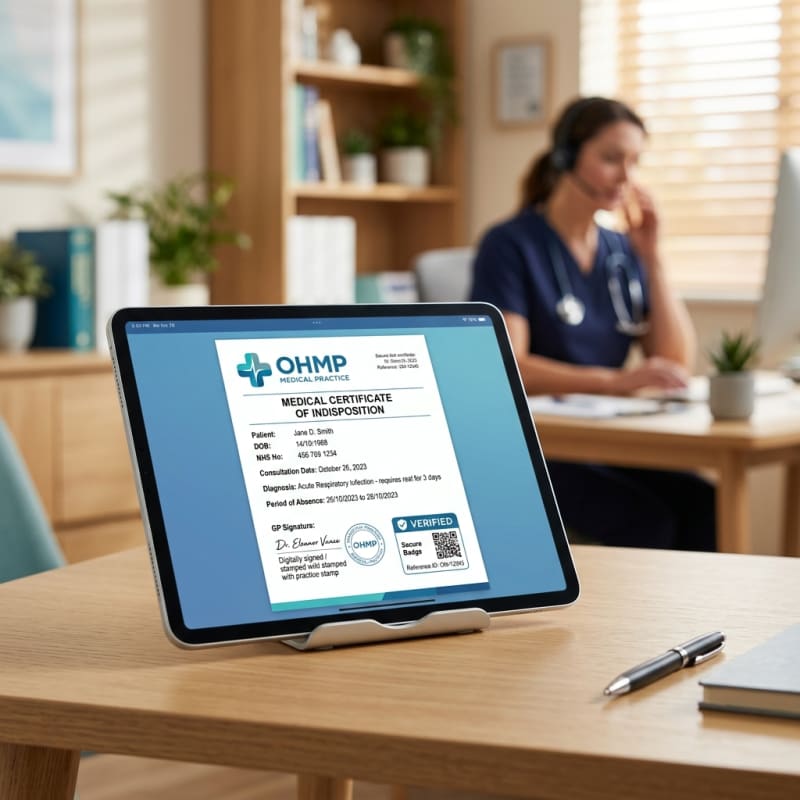
DoctorCert offers an online request for a private medical certificate. Complete the booking questionnaire accurately; a GMC-registered doctor reviews the information and may decline the request or need further information. This is a documentation assessment, not a replacement for examination, tests, treatment or your usual care team. Check the service scope, price and refund policy before booking.
Workplace Risks of Having No Medical Evidence
Tell the employer promptly what happened, what evidence you do have and what you are doing next. Ask how it will handle any delay. Avoid assuming that a refusal either proves you can work or automatically removes all sickness and employment rights.
- Late receipt of a fit note alone is not grounds to withhold SSP. Notification and eligibility rules remain relevant.
- Company sick-pay conditions and attendance procedures need to be checked separately.
- Disability and other employment protections are not created or removed simply by buying or lacking one private certificate.
If further evidence is genuinely needed, seek an appropriate independent assessment and be honest about the previous decision and the dates. Confirm what the recipient will accept. Do not seek wording designed to conceal the first assessment or guarantee a preferred employment outcome.
If disciplinary or capability action is proposed, obtain employment advice about the process and the circumstances. A private letter may be relevant evidence, but it does not make dismissal impossible or replace the employer's investigation and legal duties.
Keep communication factual and agree when you will next update the employer. If there is a disagreement about evidence, request the relevant policy and the reason in writing. That record is more useful than assuming either side's motives.
Where a private assessment may be appropriate
Before payment, ask the recipient to confirm the document and dates it needs. If it wants a statutory or specialist form, check that the service can provide it rather than assuming that a general private letter is interchangeable.
Before using a private assessment, confirm these points:
- Explain the symptoms, relevant dates and how they affect your work in the booking questionnaire.
- A GMC-registered doctor reviews the request. Issuance and the dates covered depend on that assessment.
- If approved, the private certificate is sent digitally. Confirm that the recipient accepts this evidence before requesting it.
- If the doctor cannot issue a certificate, the published refund policy applies. Seek appropriate medical care for symptoms.
Use accurate dates and describe the symptoms and work effects in your own words. The booking questionnaire is an information-gathering step, not a promise that the reviewing doctor can issue the requested evidence.
Frequently Asked Questions
Can a GP legally refuse to give you a sick note in the UK?
Yes. A clinician may be unable to issue a fit note where the assessment does not support it or the information is insufficient. Ask for the reason and the appropriate next step; a certificate is not an automatic entitlement following a request.
What should I do if my GP refuses my sick note request?
Ask for the reason, clarify any missing information and follow the recommended assessment or treatment route. Keep the employer informed. If considering another provider, explain the earlier decision and confirm that the recipient accepts the document offered.
Are private medical certificates legally accepted by UK employers?
A private medical certificate is clinical evidence following an assessment; it is not automatically the same document as a statutory Med3 fit note. An employer may agree to accept appropriate alternative evidence. Confirm the required document before paying, especially for SSP. A GMC registration number or verification code confirms the issuer or authenticity, not guaranteed acceptance or entitlement. See GOV.UK evidence guidance and employer acceptance of private evidence.
What happens if I stay off work without a sick note?
Ask payroll to explain any disputed pay decision in writing. Keep the distinction between late notification, delayed medical evidence and a contractual condition clear; they are not the same issue.
How does DoctorCert verify its certificates for employers?
The recipient can check the doctor's registration on the GMC register and contact the issuing service through a published contact route if authenticity needs checking. A GMC entry confirms registration, not that a particular document was issued or must be accepted. Do not send full medical records to an unverified contact.
Need a medical certificate?
If more information or another type of assessment is needed, follow the clinician's advice. A certificate cannot replace treatment or a safety assessment. Contact the service through its published route if the administrative process is unclear.
Sources and guidance
Guidance checked on 9 October 2026. GOV.UK SSP amounts; GOV.UK sickness evidence.
Example: clarify the dates before seeking another provider
If the request concerns the first few days of a new absence, ask whether self-certification is the appropriate evidence. If it concerns a later period, explain the dates, symptoms and job effects and ask what is missing from the assessment. Record the answer and update the employer. This separates an administrative misunderstanding from a clinical disagreement and avoids paying for evidence the recipient has not agreed to accept.
Choose the process that can answer the actual problem
If the difficulty is a missing work history or unclear dates, ask the clinical service how to provide that information. If symptoms have changed, seek an appropriate reassessment and explain what is new. If the problem concerns the appointment or the way the service handled the request, ask about its complaints procedure. These routes may overlap, but none promises a particular certificate. Record the response and any next appointment so you can give the employer an accurate update.
If the employer has refused pay, ask whether the issue is SSP eligibility, sickness notification, the document supplied or a contractual condition. Request the reason and relevant policy in writing. A complaint about a GP cannot decide payroll entitlement, and an employer cannot instruct a clinician to adopt a predetermined medical opinion. Keep the two records separate. Where advice is needed, explain the actual decision and dates rather than only saying that the sick note was refused. This helps the adviser identify the appropriate dispute route.
Keep a short action log after refusal
Write the assessment date, the reason given and the next step recommended. If you request reassessment, explain what has changed or what information was missing. Do not conceal the earlier decision or ask a second clinician to repeat a predetermined wording.
For the clinical reasons behind refusal, read why doctors may refuse evidence. A service complaint, reassessment and an employer pay dispute are separate processes with different decision makers.
- Tell the employer what evidence is available and when you will update it.
- Seek appropriate care if symptoms are worsening.
- Ask what document is accepted before paying another provider.
Editorial sources and scope
Sources checked on 16 October 2026: GOV.UK guidance 1; GOV.UK guidance 2.
This article provides general information. It is not an individual clinical assessment or employment-law decision. A private certificate is issued only where the reviewing doctor can support it, and the recipient decides whether it meets the required purpose.
In Great Britain, disability protections depend on the Equality Act definition, including the effect on everyday activities; a diagnosis or long absence alone is not the whole test. Northern Ireland has separate disability discrimination law. Ask for advice about your circumstances rather than assuming that one rule covers every workplace.