By DoctorCert Clinical Team
Who Can Issue a Fit Note in the UK?
Learn who can legally issue a fit note in the UK, including doctors, nurses, occupational therapists, pharmacists, and physiotherapists.

A lot of people still believe only a GP can issue a fit note. That used to be the common assumption, and many employers still talk as if a sick note is only valid if it came from a doctor at the local surgery. That is no longer the full legal position.
The rules changed in July 2022 so a wider group of healthcare professionals can certify fit notes. The aim was to make the system more practical and reduce unnecessary delays where another clinician was already involved in the patient’s care.
The answer is wider than many people expect, but it is also more nuanced than a simple list of job titles. A professional can only issue a fit note when they are acting within the right role, in the right setting, and after an appropriate assessment.
Quick answer
In the UK, fit notes can be issued by doctors, registered nurses, occupational therapists, pharmacists, and physiotherapists. That is the current official position under DWP and Department of Health and Social Care guidance.
But the list of professions is only part of the answer. A fit note still needs to follow a proper assessment of the patient’s fitness for work. The clinician should be in a position to assess the condition and understand how it affects work. It is not just a matter of holding the right professional title.
Why people still think only GPs can issue fit notes
For years, fit notes were strongly associated with GPs. Patients were used to going back to their surgery even when they had already seen another clinician. That old habit is still reflected in a lot of outdated web content and in workplace conversations where people still say you need to be signed off by your GP.
The 2022 change was designed to cut that unnecessary loop. If a nurse, occupational therapist, pharmacist, or physiotherapist is already properly involved in the person’s assessment and care planning, the system no longer requires everything to go back through a doctor by default. That makes the process more flexible, but it also means many older assumptions are now wrong.
The five professions that can issue a fit note
The current guidance recognises five professions as able to certify fit notes. The legal list is simple, but each profession still has to act within scope and in a setting where the assessment can be done properly.
Doctors
Doctors remain the profession most people recognise in this role. That includes GPs and hospital doctors involved in the patient’s care. In many ordinary sickness cases, a doctor is still the person who issues the note, especially in primary care.
Registered nurses
Registered nurses can now issue fit notes where their role, training, and setting support a proper assessment of the patient’s fitness for work. This is one of the changes that catches employers by surprise because many still assume nurse-issued notes are somehow outside the rules.
Occupational therapists
Occupational therapists are often well placed to assess how a condition affects day-to-day function and work activities. That makes them a logical part of the expanded group of professionals who can certify fit notes.
Pharmacists
Pharmacists are on the list of eligible professions, but this area needs careful explanation. The official guidance does not mean every community pharmacy can offer routine walk-in fit notes. The setting and the pharmacist’s role matter, and access to the formal fit note process is not universal across all pharmacy contexts.
Physiotherapists
Physiotherapists may be particularly relevant where a musculoskeletal problem affects work. If they are appropriately involved in the person’s care and able to assess fitness for work, they can be a valid issuing professional under the current rules.
Why the clinician still needs the right role
The safest public explanation is not simply that any person in those five professions can sign someone off on demand. The official guidance says the professional should be suitably trained, appropriately experienced, and acting within their scope of practice. They also need to be in a position to carry out the assessment properly.
A fit note can be based on a consultation with the patient or on consideration of a written report by another health professional. Either way, the note still depends on a responsible clinical judgement. It is supposed to capture the functional effect of the patient’s condition on work, not act as a general certificate service.
That is why broad statements such as "a pharmacist can always sign you off" are too loose to be accurate. The law widened the pool of professionals. It did not remove the need for proper assessment and role-based judgement.
Can a community pharmacist issue a fit note?
This is one of the most misunderstood points. Pharmacists are one of the eligible professions, but the employer and healthcare guidance also make clear that community or high-street pharmacists do not generally have access to the official Med3 form in the same way as clinicians working in settings such as GP practices or hospitals.
So the accurate answer is not that any pharmacist can issue a fit note over the counter. It is that pharmacists are one of the professions legally able to certify fit notes, but only where the clinical setting, systems, and role support that process. That nuance matters because it stops the article from drifting into a misleading simplification.
What the assessment is really about
A fit note is not just a certificate that confirms a diagnosis exists. The assessment is about how the condition affects fitness for work. That can include questions about pain, fatigue, concentration, sleep, mobility, medication side effects, or whether the person could work with changes rather than being completely away from work.
This matters because it explains why the issuing professional must be properly involved in care or assessment. The note is not meant to be an administrative rubber stamp. It is supposed to reflect a clinical judgement about function and work. That is true whether the note comes from a doctor, nurse, physiotherapist, occupational therapist, or pharmacist acting within the right setting.
Once you understand that, the expanded list of professions makes more sense. The system is not saying all five professions do identical jobs. It is saying each of them may be able to assess fitness for work in the right clinical context.
Are digital fit notes valid?
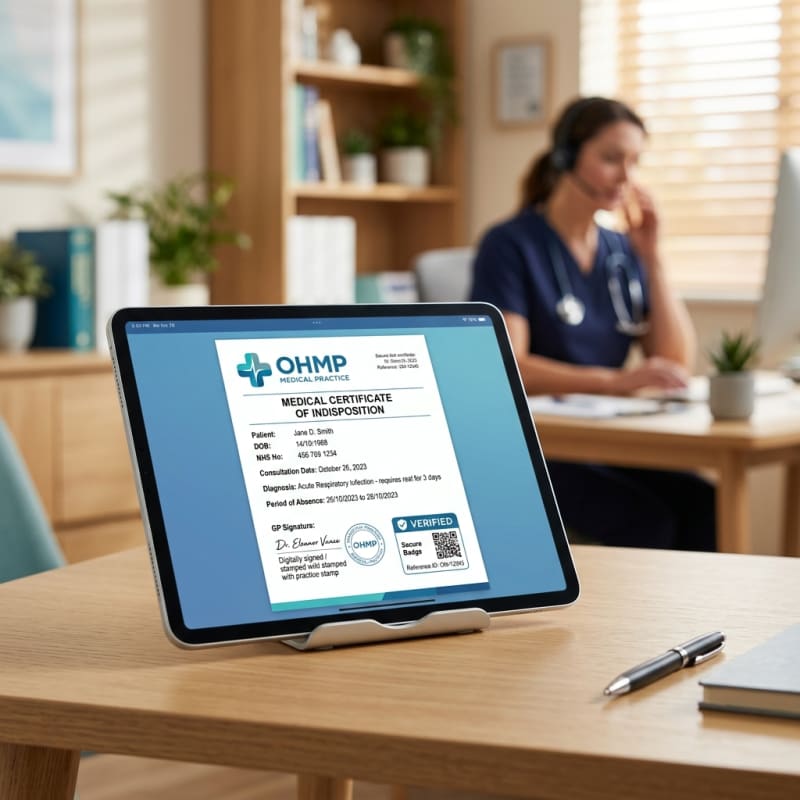
Yes. The current guidance recognises digital fit notes as valid. A fit note does not need to rely on an ink signature to count. The key issue is whether it has been issued properly by an eligible healthcare professional after assessment.
That matters because some employers still treat digital evidence as suspicious or less official than paper. That is not the right test. The proper questions are who issued it, whether they were eligible to do so, and whether the note was issued through the right process.
If you want to understand what information appears on a genuine note, our guide to what a sick note looks like in the UK is a useful companion to this article.
What a fit note can actually say
The fit note system is built around two basic outcomes. A professional can say the patient is not fit for work, or they may be fit for work if certain changes are made. That second option is one reason the issuing professional needs to understand the functional effect of the condition rather than just confirming that the person has seen a clinician.
The note is not a general-purpose letter and it is not designed to certify that someone is completely fit in every sense. It is narrower than that. It is focused on work and the effect of health on work. That practical purpose is part of what ties the issuing rules, the assessment, and the note format together.
Why this matters for patients and employers
Understanding who can issue a fit note helps patients avoid delays and helps employers judge evidence properly. A note should not be dismissed because it came from a nurse, physiotherapist, or occupational therapist if the professional was eligible and the note was properly issued. Equally, a receiving organisation should not assume that every healthcare setting can issue an official fit note simply because one of the listed professions works there.
This is also where the distinction between official fit notes and other private medical evidence becomes important. If the question is about broader private documentation, you can also read about private medical certificates. But if the issue is the formal fit note system, the profession, setting, and assessment process are what matter most.
If you want the wider framework as well, our complete fit note guide explains how fit notes work beyond just the question of who can sign them.
What employers should look for on the note
For employers, the practical test is not whether the note came from the profession they expected. It is whether the note has been issued through the proper fit note process and contains the information that shows it is genuine. The emphasis should be on the issuing route and the assessment, not on outdated assumptions about job titles.
That is one reason digital notes and notes from non-doctor professionals should not be dismissed out of hand. If the document is validly issued by an eligible professional acting in the right setting, it should be treated as a proper fit note.
That approach also protects employers from making mistakes based on outdated myths. The current system is broader than many workplace policies still assume.
Why the 2022 change matters in practice
The expansion of fit note certification was not just a technical legal update. It was meant to reduce friction for patients who were already being cared for by another professional. Without that change, people could end up being sent back to a GP simply to have a form reissued by a profession employers happened to recognise, even when another clinician already had the right knowledge of the case.
For patients, that can mean fewer delays. For employers, it means the evidence should now be judged against the current system rather than old habits. The practical benefit only appears if both sides understand that the rules changed.
Why the setting matters as much as the profession
A job title alone does not tell you whether a fit note can be issued properly. The clinical setting matters because the professional needs the right systems, enough knowledge of the case, and a legitimate role in assessment or care planning. That is why the official guidance is comfortable with several professions but still careful about how and where they should issue notes.
This is especially relevant for pharmacists. The profession is on the list, but the setting still controls whether an official fit note can be generated in practice. That is a good example of why accurate public advice has to go beyond a one-line list.
If you need private medical documentation after clinical review, DoctorCert can help you start that process online. If the question is specifically about the UK fit note system, use the official issuing rules as your reference point.
Frequently Asked Questions
Can only a GP issue a fit note?
No. Fit notes can also be issued by registered nurses, occupational therapists, pharmacists, and physiotherapists where they are acting within the right role and setting.
Can a hospital doctor issue a fit note?
Yes. Hospital doctors can issue fit notes where they are involved in the patient’s care.
Can a pharmacist issue a fit note?
Pharmacists are one of the eligible professions, but that does not mean every high-street pharmacy can issue official fit notes routinely. The setting and the pharmacist’s role still matter.
Does a fit note have to be on paper?
No. Digital fit notes are valid as long as they have been properly issued by an eligible healthcare professional.
Does the clinician need to assess me first?
Yes. A fit note should follow an assessment of fitness for work, whether through consultation or consideration of a written report from another health professional.
Need a medical certificate?
If you need signed medical evidence for work, study, or administrative purposes, you can request a private medical certificate online from a GMC-registered doctor, usually issued within 2 hours during business hours. See the one-off pricing and how private medical certificates work before you start.